JBL – Block Out The Chaos
How do you shut out the world when the noise won’t let you forget it?
“Block Out The Chaos” is a JBL campaign built on a simple contrast between two opposing states: intense noise and the calm the headphones make possible. Rather than centring the message on the product itself, the campaign draws on recognisable situations and shows the value of shutting out your surroundings. The “Wife & Daughter” creative is one example of this approach.

When silence commands attention
JBL’s “Wife & Daughter” creative rests on a simple but powerful idea: the noise isn’t shown — it’s subtracted.
At the centre of the frame sits a calm man. On either side of him we see his wife and daughter, mouths open mid-scream. Between the figures lies a white space that forms the shape of over-ear headphones.
It’s a visual metaphor for silence: the product doesn’t need to be shown outright for the viewer to grasp what it does.
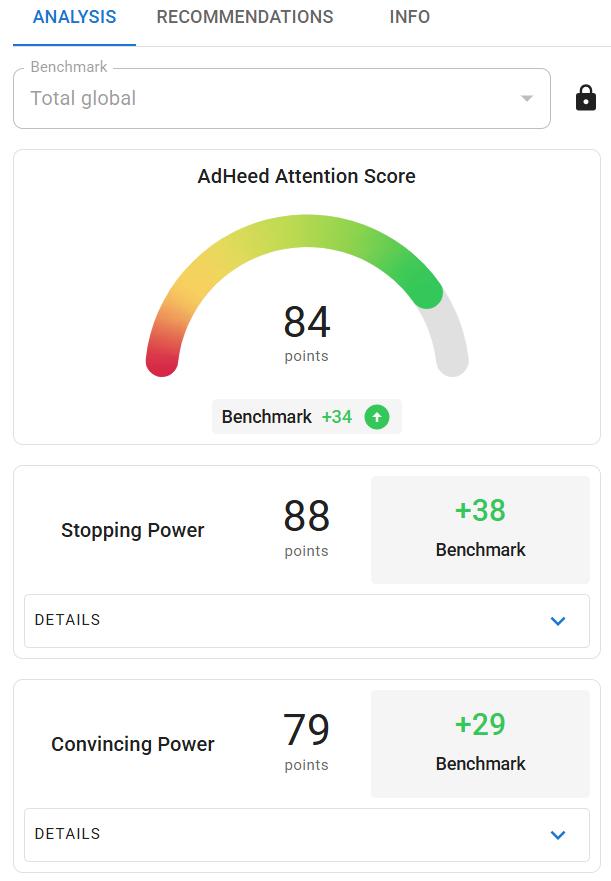
84 Attention Score points.
88 Stopping Power points.
AdHeed’s measurement confirms that the idea isn’t merely striking,
but genuinely stops the eye.
Attention Score: 84 pts
+34 pts vs. benchmark
Stopping Power: 88 pts
+38 pts vs. benchmark
The heatmap shows that attention concentrates above all on the protagonist’s face — right at the centre of the message. Rather than scattering across the whole creative, the eye quickly lands on the element the ad’s idea rests on.
Why does this creative work?
Its effectiveness comes down to three mechanisms working at once.
- The face
The protagonist’s large face, turned directly towards the viewer, is a natural focal point. It’s one of the strongest attention triggers and something that can be processed very quickly, before the viewer consciously decides whether to engage with the ad. In the report, this mechanism is linked to System 1 processing.
- Emotional contrast
Two faces expressing extreme emotion are set against one that is calm and relaxed. We read the difference almost instantly, without having to consciously analyse the whole scene. It’s this contrast that builds tension and helps hold attention on the frame.
- Mirroring
The protagonist’s calm works like a promise in the form of a reflection. The viewer can easily imagine themselves in a similar situation — on the other side of the noise, but at peace. This lets the ad communicate the benefit without having to show the product or its function directly.
On top of this comes maximum cognitive simplicity: one claim, one metaphor and one core message. Nothing competes with the idea.

What could be improved?
Despite its very high scores, the creative doesn’t make full use of every lever for capturing attention visually.
Above all, it lacks a single dominant colour that would form a clear visual block from a distance. In large formats this need not be a significant problem, but in small formats or a fast-scrolling feed this strength may be weaker.
The second limitation is the way the product is presented. The headphones appear only as negative space — the protagonist neither puts them on nor uses them. In the measurement, this translates into usage credibility of 1/5. From a product-demonstration standpoint, it is therefore the weakest element of the creative.
At the same time, this is a deliberate artistic choice. The ad doesn’t try to prove the product’s functionality by showing it directly. Above all, it sells the benefit: calm in a world full of noise.
“Block Out The Chaos” — the wider context of the creative
“Wife & Daughter” is part of JBL’s broader “Block Out The Chaos” campaign concept, which takes as its starting point the noise audiences know from everyday life and popular culture.
The campaign draws on various situations and juxtapositions in which the chaos grows ever more intense — from crying babies and barking dogs, through domestic arguments, to bawling football coaches and politicians.
The mechanism stays the same: the more chaos the ad shows, the more desirable the calm offered by the product becomes.
It’s precisely this context that reinforces the simplicity of “Wife & Daughter”. There’s no need to show the noise itself — simply setting it against the protagonist’s calm is enough for the viewer to quickly read the meaning of the whole scene.
A concept that sells the benefit, not the product
JBL’s “Wife & Daughter” creative is an example of brand advertising in which the product can remain almost invisible, provided the idea itself communicates its value clearly enough.
At the same time, the AdHeed results reveal a meaningful difference between holding attention and demonstrating the product. The creative is highly effective at drawing the eye and building positive association, but it limits the evidential layer — the real product is neither used nor shown directly.
This is where the greatest room for improvement lies, yet it doesn’t undermine the strength of the concept itself.
AdHeed shows that the idea also works at the attention level: the creative not only stops the eye but directs it exactly to where its core message sits.
This is an ad that doesn’t need to show the product to sell its value. It shows the effect in order to sell the need.